


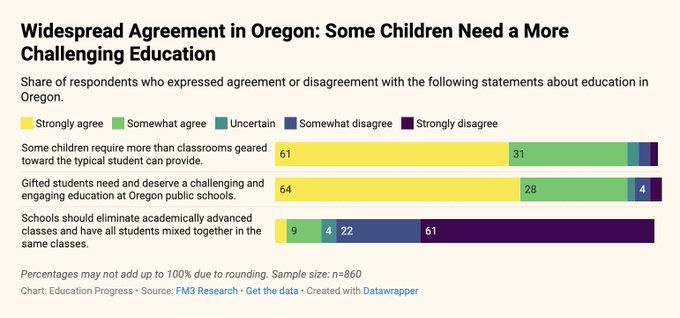
Gifted students need to be challenged, say 91% in Oregon

High achievers need challenging classes, say more than 90 percent of Oregon voters in a Center for Educational Progress survey.
Two-thirds support a proposal to guarantee funding for gifted and talented programs in the state education budget. Democrats, Republicans and Independents are equally supportive of the idea.
"Oregon’s gifted students from rural, low-income, and racially diverse backgrounds are most likely to be overlooked,” said Margaret DeLacy, president of the Oregon Association for Talented and Gifted. Half of the state's school districts do not offer services for Talented and Gifted (TAG) students.
A new Ohio bill automatically enrolls students who test as "advanced" in eighth-grade algebra, writes Jessica Poiner. But the bill was amended to make it hard for students who test at the next level, "accomplished," to get into the class. They'd need a recommendation from both the school principal and the student’s classroom teacher.
Using subjective measures, such as teacher recommendations, means fewer high-scoring minority and lower-income students will be placed into eighth-grade algebra, RAND reports. Tests scores are fairer.
"Delaying algebra until ninth grade denies high-achieving, low-income students the opportunity to take calculus or high-level statistics as juniors and seniors," writes Poiner. "Not only that, it likely forecloses advanced physics, chemistry, or computer science courses that require strong mathematical skills as a prerequisite."


...for girls. Low-achieving boys have demonstrated that they will pursue and succeed in Physics, Engineering and Computer Science (PECS) in college. Much to the consternation of those trying to achieve numerical parity between men and women in those fields. Perhaps if gifted classes were presented as being an affirmative action for girls they would fund them?
In educationally leading competitor nations, algebra is integrated into seventh-grade mathematics, with intermediate algebra completed by ninth, automatically leaving their pupils 1-2 years ahead of their American peers: unless we fix this, we are leaving our nation at a competitive disadvantage at a time when a new Cold War appears to be re-emerging, as American educators sleepwalk through world history.
Gifted students are often overlooked or ignored by most K-12 systems as many of them are not challenged in a way that would make sure they obtain an education which is equivalent to their ability... More often than not, many advanced students (if not grouped with peers who have
similar abilities will be left to their own devices, or asked to help and assist regular or slow
learning students in their classroom.
At the federal level it is estimated that approximately an additional $2.50 to $4
is allocated to each student defined as gifted or high achieving
"That Water would certainly wet us, as Fire would certainly burn:"
Rudyard Kipling