


Quick, easy, worthless: Students let AI do the thinking and learning

Nearly every one aced the take-home midterm in Brown professor Roberto Serrano's economics class. When he told students they'd have to take the final in person, many of the high scorers dropped the class. With two exceptions, scores were much, much lower on the final, an Inside Higher Ed chart shows. Students who'd scored in the 90's on the midterm, fell to the 50's.
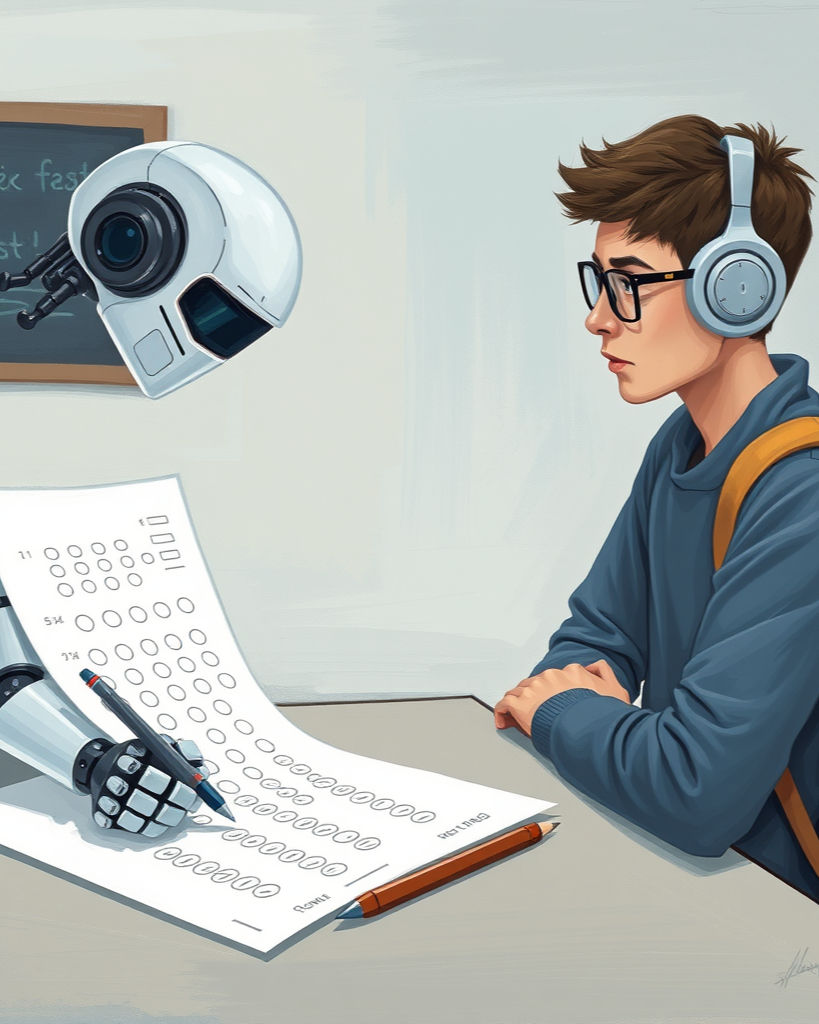
AI has made cheating very easy, Serrano told Business Insider. He respects the two non-cheaters: One got 95.5 on the midterm and 95 on the final, while the other earned a 55 on the midterm and a 59 on the final. Serrano said he'll never give another take-home exam and will not base any part of students' grades on work done at home.
Students are "completing assignments faster while learning less," reports Hechinger's Jill Barshay, citing an analysis of millions of student interactions with the ALEKS online math platform. Researchers say fifth-grade through college students speed through word problems that are easily outsourced to AI, but when it's harder to use AI, such as in graphing problems.
College students who do poorly on a math placement test can take practice tests on ALEKS and retake the placement exam. "Before ChatGPT, that practice generally paid off," writes Barshay. "After ChatGPT, students answered more word problems correctly during unsupervised practice sessions but performed substantially worse on those same kinds of problems when they later took a proctored placement test." There was no change in performance on graphing problems.
There's no proof that it's AI, writes Barshay. But there's no other plausible explanation. "The changes appeared only in problems that are easy to outsource to AI, disappeared under supervision and grew steadily over nearly three years."
“What makes me nervous is that it’s not only about the word problems,” researcher Sina Rismanchian told her. “This cognitive surrender might be going on in writing, science, everything.”
Other research supports students' fears that AI is weakening their critical-thinking skills, Barshay writes. "Carefully designed AI tutors have improved student achievement in controlled experiments by asking questions, personalizing instruction and withholding answers until students reason their way through a problem," she writes. But few students are using AI this way. If they were, they'd be working slower, not faster.


Oh no! When you incentivize and reward the getting of good grade instead of real learning, kids learn how to get the good grades. In the past they hacked the teacher, i.e. figured out what they expected on the test.
Real learning in school is punished as the student will ask questions or they will have too nuanced an understanding of the material thus not regurgitate the expected answer on the test.
If schools, parents, teachers and colleges looked for real learning instead of grades, the students would have to actually learn something other than how to use AI to get the grade.
Here is how a search engine AI summarizes Paul Graham's December 2019 essay