


Chromebook remorse: Teachers relearn face-to-face teaching


In January, math teacher Dylan Kane took his seventh-grade students' Chromebooks away, writes Jenny Anderson in The Atlantic. An early enthusiast for technology with own math-instruction website, the Colorado teacher had become disenchanted. "Within weeks of ditching the screens, he saw how they had been holding both him and his students back," writes Anderson, a senior fellow at the Center for Teen Flourishing and a co-author of The Disengaged Teen: Helping Kids Learn Better, Feel Better, and Live.
"About 90 percent of school districts provide every student with a school-issued laptop or tablet," she writes. In a 2021 survey, teachers said "more than half had their students use screens for up to four hours a day, and more than a quarter had students spend at least five hours on screens in a typical school day."
Teachers are told to "differentiate" instruction for students at very different levels of achievement. Education technology promises to adapt lessons to "each student's interests and skills," writes Anderson.
Yet Kane struggled to capture his students' attention. He found himself "spending precious minutes managing the transition to and from screens, reconnecting to the internet, troubleshooting the inevitable problems: the charger that wouldn’t work, the software that inexplicably blocked the wrong websites, the Chromebook that was suddenly dead."
After reading Jared Cooney Horvath's anti-tech book,The Digital Delusion, Kane decided to try teaching without Chromebooks. "Not only did he lose less time futzing over lost chargers and bad links, but he also noticed right away that his students paid more attention to what he said," writes Anderson. He could notice when a student was confused and provide help.
. . . all of the dashboards and data analytics of ed tech did not make the individual needs of students clearer, nor did they much help those who were struggling. Instead, the screens offered students cover, a way to appear engaged without any actual sustained effort.
Education is social, the teacher realized. “Students benefit from being in a room with a bunch of other people who are learning the same thing, the collective effervescence of all trying to make progress together,” he said.
In the comments, programmer jmogily writes: "Screens are candy. Kids need to learn to eat their vegetables."
In a conversation with Chalkbeat's Matt Barnum, Kane says he's working harder as a low-tech teacher, and so are his students. Instead of having students work on their own, he's teaching the class, asking questions and having students answer on mini-whiteboards. He has to grade quizzes and tests by hand. "It’s helped me get students to engage more with their mistakes, but again, it’s more work."
Students miss the instant feedback they get from screens, says Kane. "Instant feedback can be really helpful, but students can also become reliant on it, or it can lead to guessing and checking that’s unproductive." Delayed feedback can be more effective.
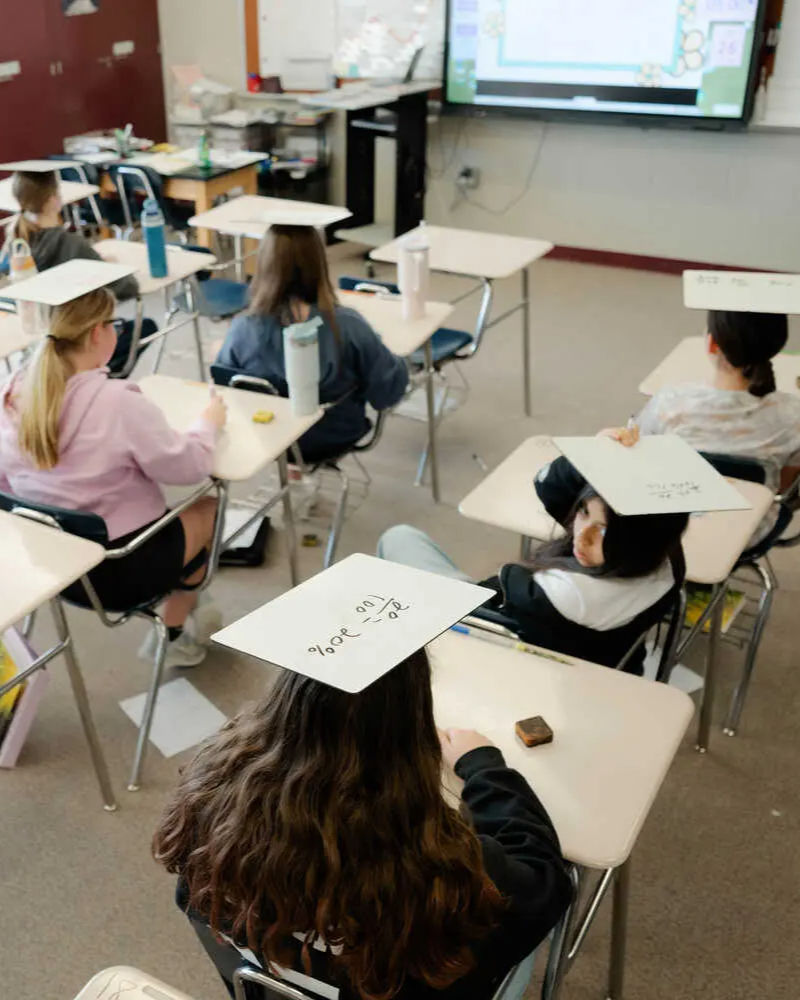
Chromebook remorse has come to McPherson, Kansas, reports Natasha Singer in the New York Times. Four years after banning student cellphones, McPherson Middle School has asked students to hand in their Chromebooks. They laptops sit in carts to be used for a few activities.
“We just felt we couldn’t have Chromebooks be that huge distraction,” said Inge Esping, 43, the school's principal.
"After tens of billions of dollars of school spending on Chromebooks, iPads and learning apps, studies have found that digital tools have generally not improved students’ academic results or graduation rates," writes Singer. Some warn that "overreliance on technology can distract students and impede learning."
Schools across the country are rethinking their reliance of laptops. "Parents are flocking to support efforts, like Schools Beyond Screens and the Distraction-Free Schools Policy Project, to vet and limit school tech."
McPherson bought a $225 Chromebook for every middle schooler in 2016. The school paid for online textbooks and learning apps. “The general idea was: Students are going to be more engaged because it’s online — and how exciting for them!,” Esping recalled.
However, "administrators, parents and students found that some of the platforms seemed too gamelike or did not work as advertised," Singer writes.
Even after Spotify and YouTube were blocked on school laptops, teachers said "they were spending so much time policing student Chromebook use that it was detracting from teaching. Some parents complained their children were spending hours playing video games on their school-issued devices."
Now tech use is minimal and intentional, Singer writes. In an English class, most seventh-graders chose to answers questions with pen and paper instead of using a class Chromebook.
"In a sixth-grade lesson on fractions, a teacher asked the class to convert three-twentieths into a percentage," she writes. "Students each worked on the problem on small dry-erase boards. They balanced the boards on their heads to indicate they were ready to be called on."
Students are talking more to each other, said Sarah Garcia, 13. “Since we don’t have our Chromebooks in front of our face,” she said, “most people now interact with their, like, peers and stuff.”


What a positive development! Happy to hear it.