


An 'AI-themed school' means ... ???

AI is hot, and districts from Boston to Miami have caught the fever, writes Jessica Grose in a New York Times commentary. Advocates think AI, used correctly, "can give children a more precise, dynamic and individualized learning experience." But what should an AI-centric school look like?
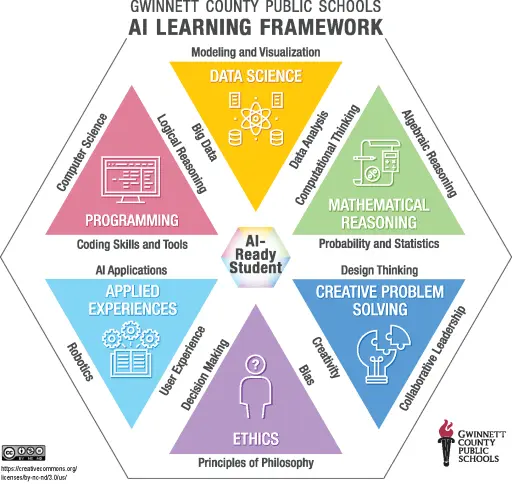
In an Atlanta suburb, a cluster of schools -- a high school and its feeder elementary and middle schools -- are trying to infuse AI into the curriculum in every grade, she reports. But much of the AI use she describes seems peripheral to the work of teaching and learning.
In a first-grade class, the teacher explained the word "sturdy" and urged students to build sturdy homes for their group's plastic figurine. “She’s our user, right?," said the teacher. "We’re using our ‘user experience’ where we’re going to think, how can you build a strong home for her?” That phrasing made the lesson part of the artificial intelligence learning framework, represented by one side a light-blue "applied experiences" triangle. “ (The other triangles stand for “programming,” “data science,” “mathematical reasoning,” “creative problem solving” and “ethics.”"
At a middle school, Grose saw eighth-graders interview chatbots their social studies teacher created to represent Richard Russell and Carl Vinson, who brought military funding to Georgia during World War II. The teacher wrote the questions. Student were supposed to summarize the answers.
Interacting with the bots made the lesson more "student friendly," the teacher said. "The kids I observed did not seem especially riveted," writes Grose.

Seckinger High School, which opened in 2022 as an AI-themed school, features state-of-the-art mechanical engineering classrooms and glass-walled student “collaboration rooms,” she writes.
AP Human Geography students use a chatbot to gather data about Atlanta's 2014 “snowmageddon,” moving much faster than pre-AI classes.
Students use "algebraic reasoning to think more deeply about literature," rebrand word patterns as "algorithms," she was told.
An art teacher "described encouraging her students to use ChatGPT to help them free-associate words to get past artists’ block," she writes. "But wouldn’t they be just as well served by thumbing through a book of paintings, going outside and looking around, or daydreaming?"
Teachers talked about the ethics and creative problem solving triangles, Grose noted. But that "didn’t necessarily have anything to do with artificial intelligence."
So far, Seckinger High is underperforming high schools with similar demographics: Only 38.4 percent of Seckinger graduates test as “college ready” on the ACT or SAT. Another 19.4 percent complete a career, technical and agricultural education pathway.
Research on the effectiveness of AI in education is mixed, writes Grose. “A.I. tools may help students complete tasks more successfully in the moment, but those gains do not always persist when students are later asked to perform independently,” concluded Stanford’s A.I. Hub for Education in a review of more than 800 academic papers.
Penn researchers war that AI users may avoid "effortful thinking," leading to “cognitive surrender.”
"We’re in the middle of a backlash against smartphones and Chromebooks in schools just as districts are starting to contend with the infiltration of AI," writes Grose. "New York City recently paused the creation of an A.I.-focused high school in Manhattan after protests from parents."
AI advocates say schools must adapt to the technology of the future, she writes. That's what "tech boosters said about giving every child a laptop." That hasn't worked out so well.


Comments