


We're proud to be Americans -- but not quite sure what we're celebrating


Most people are grateful (86 percent) and proud (79 percent) to be Americans, a new Cato survey concludes. They believe the American dream is available for them personally (74 percent).
Seventy-one percent of those surveyed believe that the ideals and institutions of the American founding are “part of their inheritance as an American.” That feeling is strongest for seniors, the affluent and educated, whites and native-born Americans. Men feel more connected than women.
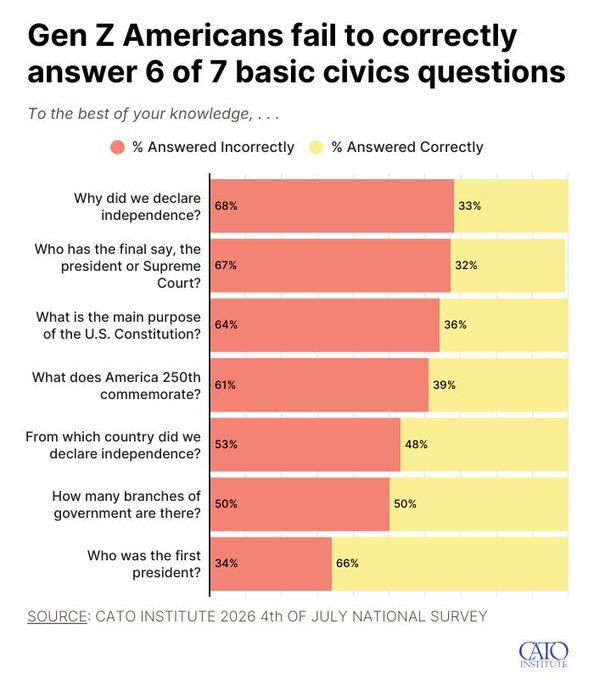
OK, only half knew that today is the 250th anniversary of the signing of the Declaration of Independence. Gen Z is especially confused -- except that they know George Washington was our first president.
Overall, two-thirds of Americans see the Founding Fathers as “courageous leaders who risked their lives and possessions to secure independence and liberty,” as oppose to "self-interested elites."
There's a huge age gap: 89 percent of seniors, but only 49 percent of Gen Z, choose "courageous leaders." The younger Americans are much more likely than seniors to say they don't know enough to have an opinion.
Many schools exposed students to the 1619 Project's claim that preserving slavery was a primary reason the American Revolution was fought. Overall, 36 percent say it's true, 39 percent say it's not and the rest aren't sure. However, young people are more than twice as likely to say it's true (47 percent) as false (21 percent).
Black Americans (51 percent) are also far more likely to believe this than not (22 percent), compared to white Americans (29 percent to 46 percent). Hispanic Americans fall in between, but more believe this (43 percent) than don’t (30 percent), Cato reports.
Whites, blacks and Hispanics are as likely (60-61 percent) to say America continues to be a land of opportunity. Only liberals disagree: Only 45 percent of liberals, compared to 74 percent of conservatives believe America is a place where people of any background can achieve a good life.
Republicans are somewhat more optimistic about the future than Democrats. Young Americans are the most likely to say America’s best days were in the past (40 percent) rather than in the future (35 percent).
Capitalism (52 percent) is viewed somewhat more favorably than socialism (37 percent) -- except for Gen Z, which leans 53 percent for socialism, 45 percent for capitalism, the survey reports. "Gen Z is the only age group with a more favorable than unfavorable view of communism (38 percent favorable, 36 percent unfavorable)," Cato notes.
The "Democratic Socialist" label is a plus for some voters and a negative for an equal number.
Gen Z Americans seem to know less about our country, and appreciate it less, than we oldsters. I wish the survey's quiz had included a few more questions. Can they define "capitalism," "socialism" and "communism." Or "fascism," for that matter.


So, those most recently under the sway of the teachers and professors know the least about our country. It's almost like that was the plan... Worst, with a bit of judicious use of AI, those suffering from miseducation could learn enough to not have to rely on their teachers. But the effort now is to dissuade students from learning on their own using unapproved sources.