


For disadvantaged boys, gifted classes are a life-changer


Placement in a "gifted" class can be a life-changer for high-ability boys from low-income and non-English-speaking families, according to a study in an an urban Florida district. They are much more likely to complete high school and enroll in college, compared to similar boys who miss the IQ cutoff. Disadvantaged girls benefit too, but not as much.
Gifted education has little effect on test scores, write David Card, Eric Chyn and Laura Giuliano in Education Next. However, it improves "success-oriented behaviors" such as taking more challenging classes and earning higher grades, their findings show. Disadvantaged students aim higher and work harder.
"Motivation, engagement, and aspirations may be just as critical" to school success as cognitive ability, they write.
Universal screening of all students, not just those recommended by teachers and parents, can identify students who need more challenge, they write.
Disadvantaged boys -- even those with high cognitive abilities -- "have very low rates of college entry," they write. Often their "low non-cognitive skills may mask their true academic potential." That is, they don't like elementary school, don't do the work and alienate teachers.
The study looked at whether third-graders said they enjoyed learning. Three out of four boys who didn't like learning but qualified for the gifted program ultimately go to college compared to one in 10 boys with similar IQs who miss the gifted cutoff. "College enrollment for girls in the low-enjoyment group jumps by around 50 percent, from a rate of 53 percent for those not in the program to 80 percent if they participate." Girls are more diligent than boys at all ages, so the effect is not as dramatic.
The "gifted" designation may not benefit advantaged students, who already are on track for success and get plenty of support from their parents. You can't judge a gifted program's quality by the fact that high-scoring students continue to get high scores, writes Matthew Yglesias. In New York City, "the level of fighting over who gets into this program and whether it’s unfair is wildly out of proportion to the scrutiny of its actual educational efficacy."


The important thing is to keep the schools from psychologically damaging the low-achieving boys so that they stop succeeding once they've been freed from the schools. In any case, college is not for men anymore. The college credential is for corporate hiring and 94% of corporate jobs have gone to women in the last few years. So unless the boys are going into engineering, college is just life crippling debt.
"compared to one in 10 boys with similar IQs who miss the gifted cutoff. "
Huh? If they have similar IQs, how do they miss the cutoff?
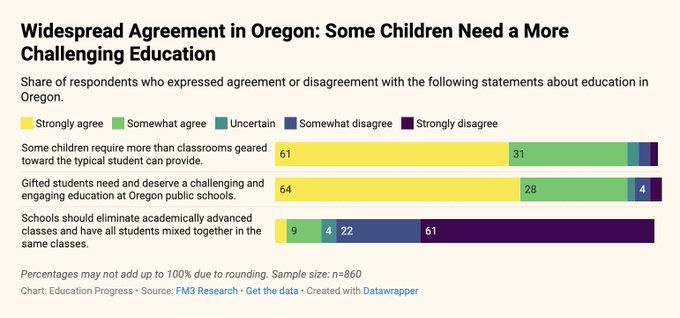
Meanwhile, we are eliminating anything that smacks of a gifted student class in the name of equity. Honors Algebra 2? Gone. AP Calculus? Gone. Bridge to College English? A thing which replaced studying Shakespeare and actual literature. Latinos in Action? A thing which apparently just promotes grievance mongering.
Last year was the first year that we eliminated the Honors designation for Algebra 2. I was suggesting to my students that they think carefully before enrolling in what was now just called Algebra 2 because it would essentially be taught the same as the Honor…