


Down in the dumps: 'Learning recession' started in 2013

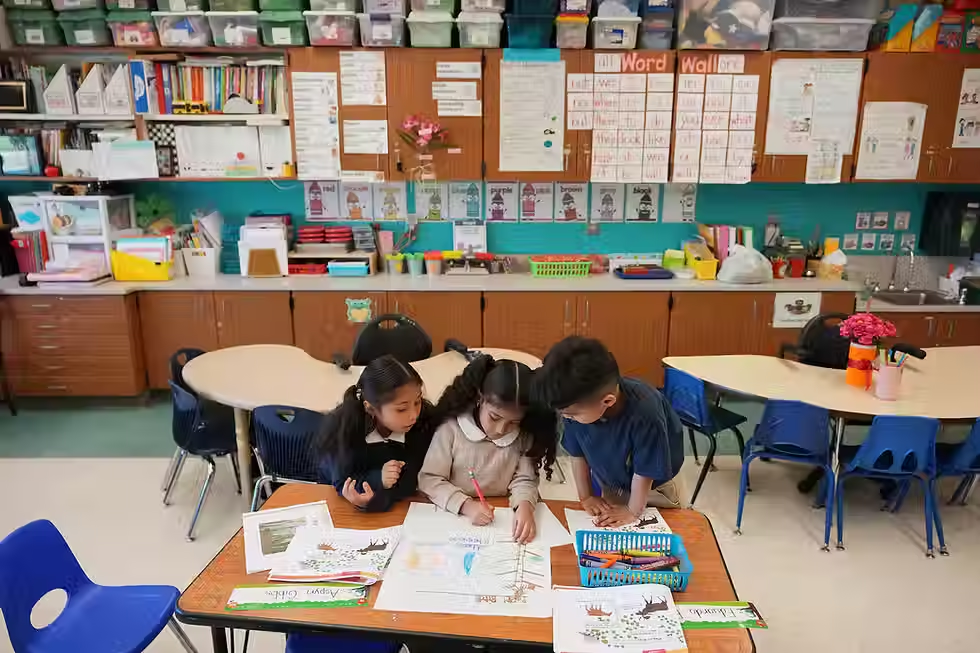
A nationwide "learning recession" started in 2013, concludes Education Scorecard. Reading and math scores fell slowly and then, during the pandemic, quickly. Scores are up since the pandemic's end, students remain nearly half a grade level below pre-pandemic reading scores and only slight better in math. In one in three school districts, students are reading a full grade level lower than they were in 2015.
"Compared with a decade earlier, reading scores were down last year in 83 percent of school districts where data was available," and "math scores were down in 70 percent," reports the New York Times. "Only a few states, like Mississippi, have avoided the plunge."
The Southern Surge holds up well: Louisiana is first in the nation for reading growth and second for math progress, according to Education Scorecard. It's the only state where student achievement has surpassed pre-pandemic levels in both reading and math.
Researchers analyzed reading and math scores for third- through eighth-graders in 40 states and the District of Columbia. (Ten states were excluded because of high opt-out rates or noncomparable data.) Here's an interactive guide to scores in every district in the report.
No Child Left Behind, which held schools accountable for improving reading and math proficiency, coincided with rising test scores, especially in math, reports the Times. "Low-performing students saw the biggest gains." However, the law was replaced in 2015, and many states weakened accountability measures.
That coincided with the proliferation of Internet-linked devices, a one-two punch. Nearly half of American teenagers now say they are online “almost constantly,” and "virtually all schools give children laptops or tablets in class, as early as kindergarten," the Times reports. Nearly one in three teenagers say they “never or hardly ever” read for fun.
Education Scorecard also looks at "districts on the rise." Among the bright spots are District of Columbia Public Schools. D.C has "invested in tutoring, and was an early adopter of the science of reading, which emphasizes direct, sequential teaching of phonics, vocabulary and other skills," reports the Times. In addition, teachers rated as "highly effective" are eligible for significant bonuses.
In Detroit public schools, proficiency rates are much lower than in most urban districts, but reading and math scores are improving, reports AP. "District leaders attribute the success they’ve made so far to a consistent strategy focused on reducing student absenteeism, a reading curriculum attuned to the science of reading, and tracking of academic data."
In California, Modesto and Compton are making faster-than-average progress. "District leaders and researchers credit years of sustained academic reforms and data-driven intervention systems."
Modesto’s test scores are still low, but they "grew enough to represent an extra 18 weeks of learning in math and 13 weeks in reading," according to Education Scorecard.
As in Modesto, "Compton Unified expects principals to closely track which students are receiving additional instructional support and whether that intervention is effective." Students take weekly quizzes and received small-group tutoring.


Another important reminder that it wasn't just the pandemic, or more precisely policies adopted in response to it. Credit to the Times for the story.