


Don't ask students to 'discover' math before they've learned fundamentals

Math teaching should be based on the science of how children learn -- not on good intentions, noble goals or vibes, argues educational psychologist Danielle Hanks in Education Week.

In many classrooms, students are encouraged to "discover" math principles, come up with multiple problem-solving strategies and explore patterns before they've mastered core procedures, such as 6 x 8 = 48, she writes. "The intention is deeper understanding. But teachers frequently report student frustration, uneven mastery, and widening gaps between those who enter with strong background knowledge and those who do not."
Research shows that "working memory is limited," she writes. Novices can be overwhelmed by trying to do too many things at once, such as compare multiple solution paths. A little struggle can be "productive," but "not all struggle signals growth. Some of it signals overload."
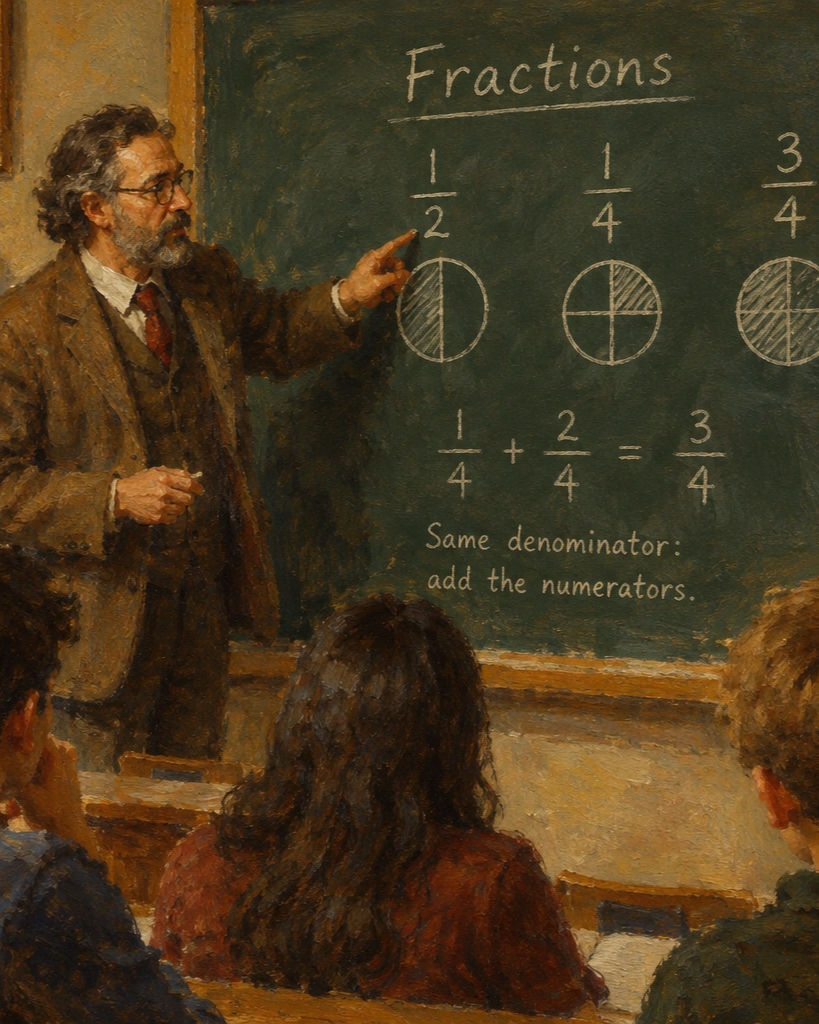
"Novice learners benefit from clear modeling and guided practice," writes Hanks. "As foundational skills become fluent, students are better able to reason flexibly."
On tests, "students should be asked to explain their thinking and apply concepts," she writes. "They should also be expected to perform procedures both accurately and efficiently." Fluency and reasoning are "complementary, rather than competing goals."
"Inquiry has an important place in the teaching of mathematics," writes Hanks. "It works best, however, when it rests on a foundation of fluency."
Math programs that look fun and engaging to adults are not necessarily effective for novices," tweets math professor Anna Stokke. "It's the curse of expertise: once you're fluent, it's easy to forget the steps and hard work that it takes to get there."
Science teacher Adam Boxer critiques a "mad and incoherent" chart that tries to blend Teach Like a Champion's techniques with inquiry-based learning, while Tom Bennett notes that "the right way to treat a gunshot wound is not 'a bit of medical science and a bit of homeopathy'."


I believe it’s called kakistocracy. The least capable are somehow in charge.