


AI + school is replicating: Is Alpha the future?

K-12 students spend two hours a day on academics -- taught by AI -- then have the rest of the day to work together on projects based on their interests, play sports, explore the wilderness, cook, code, practice public speaking and plan a business. "Guides" run workshops and provide mentoring and emotional support. There are no teachers.
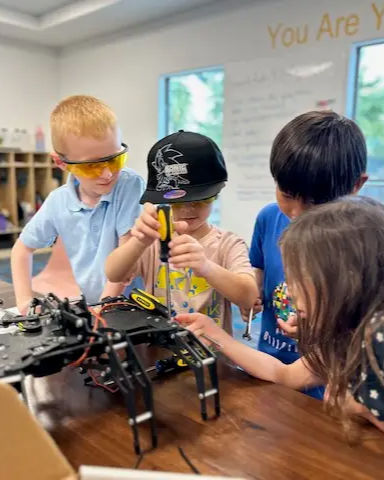
Alpha, which started as a private school in Austin in 2014, is expanding across the country, including branches in New York City, Orlando and San Francisco, writes Pooja Salhotra in the New York Times.
The “2 Hour Learning” model isn't cheap. Austin parents pay $40,000 a year. (A Brownsville, Texas campus, which serves working-class families as well as the children of SpaceX engineers, charges $10,000 a year, and has some financial aid.)
According to the network, students score in the 90th percentile, and have moved from the 31st percentile to the 86th percentile within a year. In the first graduating class, 11 students went on to four-year universities, including Stanford, Vanderbilt, the University of Texas at Austin and Northeastern, says co-founder Mackenzie Price. The 12th graduate became a professional water skier.
It's hard to to evaluate the model without a control group. Most parents are well-educated and affluent, and they've chosen this model as a good fit for their children. Students tend to be highly motivated, says Price.
Byron Attridge, 12, was home-schooled during the pandemic, then started at Alpha in third grade. As a sixth-grader, he was learning eighth-grade math, ninth-grade reading and 10th-grade language arts, he told the Times. He likes to move faster.
He worked with other fifth- and sixth-graders on an entrepreneurial project: They designed and operated a food truck specializing in breakfast food, including doing the financial planning and the cooking.
High school students work on passion projects known as "masterpieces," writes Salhotra. So far, "students have built a chatbot that offers dating advice, an emotional support teddy bear and a 120-acre mountain bike park, now the largest in Texas." Students say their masterpieces require a "spiky point of view" that AI can't provide.
“To be a useful person in the age of A.I., you have to have unique insights that A.I. doesn’t really agree with,” said Alex Mathew, 16, a rising senior at Alpha High School. “That’s the real differentiator,” he continued. “We are trying to beat A.I.”
I'm dubious about the depth of learning AI can provide in reading, writing and history. What about discussion? And I'm very sure that giving students four hours to interact with each other, play sports, etc. is a vital part of the model.
Alpha is launching a tuition-free virtual charter school in Arizona this fall. Unbound Academy will use "2-Hour Learning," but will not have a physical location for student workshops and activities. Any collaboration will be virtual.
State boards of education in Pennsylvania, Texas, Utah, Arkansas and North Carolina have rejected Unbound Academy. The outcomes for all-virtual education have been very poor.
What works in a brick-and-mortar private school for affluent children may not work in a virtual school for all children, writes Dan Meyer in a critique of Unbound's Arizona charter application.
According to the application, "at schools using 2hr Learning, students experience 2.4x the academic growth on average compared to peers in conventional classrooms, with the highest performing 20% of students achieving 6.5x growth."
But those are private-school numbers, Meyer notes. "Applying a tuition filter in the admissions process — indeed, having an admissions process at all — does a great deal to ensure engagement from both students and parents. And if students or parents fail to engage beyond that early filter, private schools have much more freedom to remove them than public schools."
He also notes that for all the talk about AI replacing teachers, Unbound's guides will be certified teachers, the application promises. There will be one guide for every 20 students, better than the average teacher to student ratio in Arizona public schools.
Meyer concludes: "The Alpha private school network, which gets great results, as far as I can tell, not by replacing teachers with AI, but by replacing poor kids with rich kids, by replacing unengaged families with engaged families."


Comments