


'You don't get fit by watching sport'

Fifteen-year-olds who use AI and social media the most did the worst in reading and math on an international exam, reports the OECD. Average achievement fell in most countries around the world on the PISA exam.
“You don’t get fit by watching sport,” OECD director for education and skills Andreas Schleicher said. “If AI makes things easy, it’s not great for you in the long run. It gives you better results, but it doesn’t enhance learning. You have to make an effort. If learning is easy, it’s not learning.”

“Skimming social media feeds and rapidly processing information may be contributing to worsening ability and motivation to engage with complex texts and data,” the report noted. It found "a reduced ability to evaluate information, think critically and bring together multiple pieces of evidence."
"Between 2015 and 2025, the average reading score dropped by 28 points for students from OECD members — which are mostly rich countries — and by 16 points elsewhere," writes Paul Hannon in the Wall Street Journal. "A decline of 20 points is roughly equivalent to losing one year of education."
Schleicher called for banning smartphones in school. “It’s the only thing that works,” he said. “The only reduction of destruction was the cell-phone ban.”
U.S. high school students spend a majority of class time on school-provided devices, according to a new Fordham survey. Three-fourths said they used these devices or their phones daily to scroll social media, play games, watch videos, message friends or shop in class, reports Brian Fitzpatrick in the report on "high school in the age of distraction." Twenty-two percent use AI without the teacher's permission.
It's not just the low achievers: 63 percent of C students and 48 percent of straight-A students say they look at social media in class every day, the survey found.
"Daily distraction and academic shortcutting have become deeply embedded habits," writes Fitzpatrick. AI use also has become the norm, and one quarter to almost half of students said they used it to avoid solving math problems, reading assignments or writing essays and reports.
"Devices have come to dominate the high school day," he writes. Sixty-two percent of respondents say school-issued devices occupy a majority of their in-class time. The more students use a device in class the less likely they are to believe that school attendance matters.
Strict cell phone policies, such as locked pouches or phones left in a central office, reduce daily social media use significantly, but not to zero.
Students who don't pay attention in class or do their own work face few consequences, writes Fitzpatrick. Many students say they faced no penalties for late assignments, got unlimited test retakes and got partial credit for work never submitted. Fifty-seven percent ) report getting “all A’s” or “mostly A’s,” including many with low test scores. Fewer than 10 percent said they got "mostly C's" or below.
The report suggests that schools limit classroom use of technology, strengthen firewalls and adopt stricter bans on cell phones. Teachers should rely more on in-class, paper-and-pencil and oral exams to evaluate students' achievement.
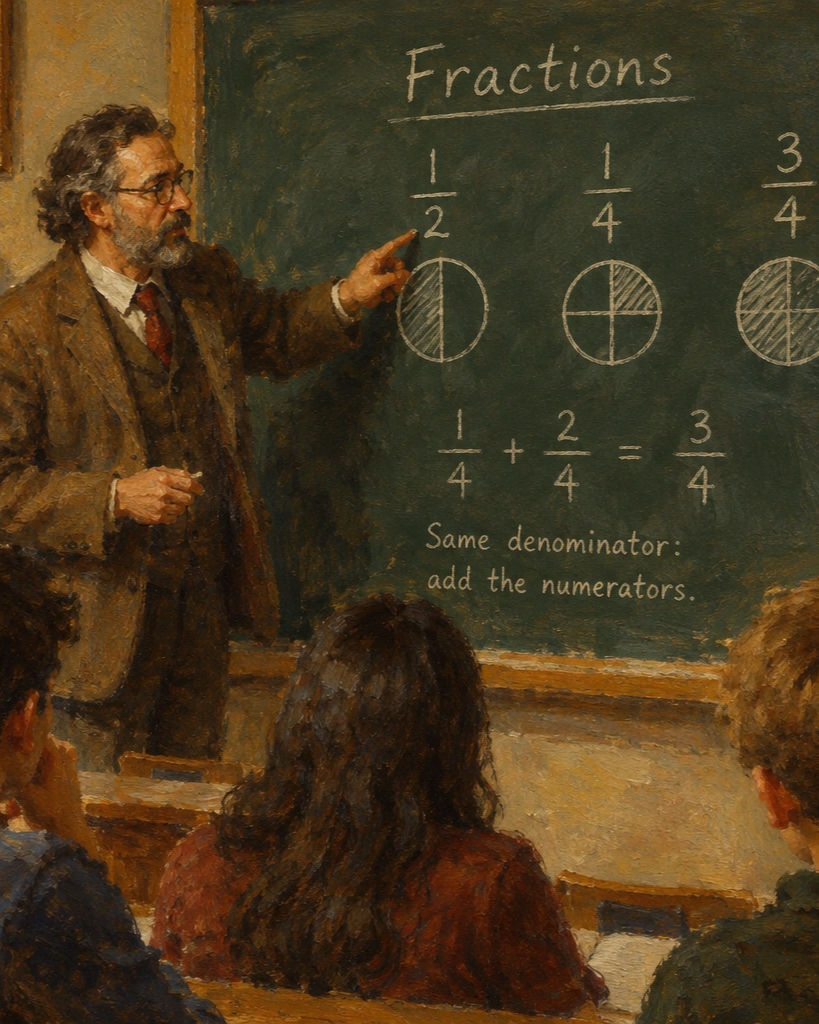

EDIP: Explain, demonstrate, imitate, practice.
Andreas Schleicher: “You have to make an effort. If learning is easy, it’s not learning.”
That depends on interpretation. I like the idea of walking around the track and gradually increasing the distance that you cover in 30 minutes, or lifting easy weights and gradually increasing the weight, or free diving to gradually increasing depth. Start the Algebra lessons with linear equations in one variable, like
2a = 12 => a = __.
1/2 b = 10 => b = __.
With illustrations, a six year-old can get this.
In 180 days they will solve
{p<a, b>, q<c,d>} subset of L and {s<g,h>, t<j,k>} subset of M =>
m(p,q) = __ (slope of the interval (p,q)
m(s,t) = __ (slope…
American teachers need to learn how to grade, in part because their influence extends into other nations, and American influence, in particular out of Silicon Valley, is pulling much of the world downward.
"Many students say they faced no penalties for late assignments, got unlimited test retakes and got partial credit for work never submitted."
This started locally sometime around 2010. The lowest possible grade for a completely skipped assignment or test is 50%. Some teachers only grade based only on whatever is turned in. Late penalties? Don't make me laugh. There is many a "Pikachu face" among our freshmen when they learn that for some mean old profs, zeroes are a real thing.