


Muddling through math: Schools search for a better way

"The idea that we would just … have kids muddle their way through" a math task at the start of a lesson "doesn’t align with what we now know about how kids learn,” Taryn Rawson told EdWeek's Sarah Schwartz.

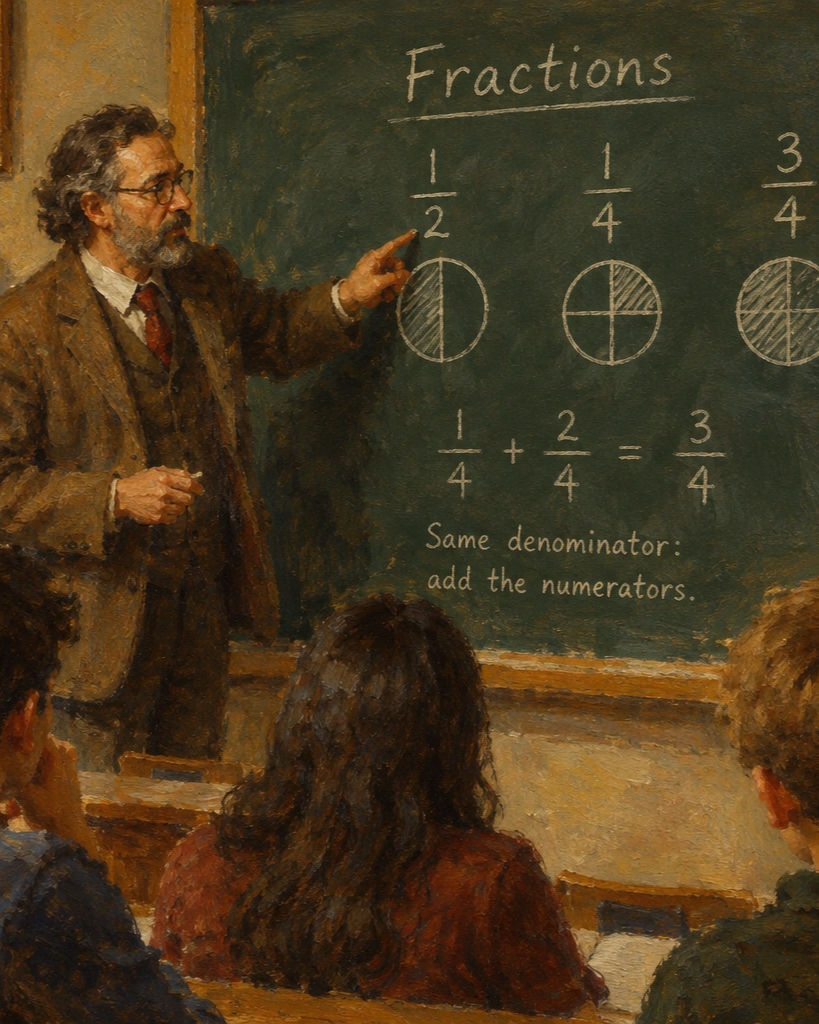
As principal of Denver's Goldrick Elementary School, Rawson has "shifted her school away from an inquiry-based program to a new core curriculum that includes more teacher-led instruction," reports Schwartz. Teachers have time to test students' math understanding and provide more help. Students get more practice on math facts.
Scores are up in both math and reading at the heavily Hispanic school.
“We’re living at the zenith of the ‘whole math’ era,” said Rawson, referencing the “whole language” approach to teaching reading, "which promoted immersing kids in books and deemphasized explicit instruction in phonics and other foundational skills." The research didn't support that.
Goldrick Elementary "went all in on the science of reading" four years ago, writes Schwartz. The school "changed its curriculum and assessments, schedule, and staffing structure to help young students master foundational reading skills, like phonics, and get them reading grade-level texts." Now it's time for math.
“Science of math” advocates want "schools and districts to align their instructional practices with findings from experimental research," she writes. Frustrated by very low post-pandemic math scores, "18 states passed legislation that pushed math teaching in a more 'structured, intervention-oriented direction',” according to a report from the Center on Reinventing Public Education. (Here's EdWeek's tracker on what states are doing.)
But the debate over how to teach math isn't settled. Believers in "inquiry-based lessons that start with complex problems rather than skill-building" argue that explicit teaching of skills doesn't build conceptual understanding.
"Laws often include a focus on foundational skills in grades K-5, requirements for universal screening and targeted intervention for struggling students, and mandates for data-based decision-making and explicit, systematic instruction," according to the CRPE analysis.
Alabama's 2022 law, which required math coaches, state-approved materials and help for struggling students, led to gains on national math achievement tests. Other states hope to follow suit.
"While these laws usually require “evidence-based” approaches and curricula, they don’t always outline what exactly that means," Schwartz writes. Most researchers and educators support "some explicit instruction, and some time for students to tackle problems on their own," but don't necessarily agree on what should come first.
"New York City’s school system now requires almost all its high schools to use Illustrative Mathematics, a program that emphasizes building students’ conceptual understanding, to teach Algebra 1," Schwartz writes. "Teachers have offered mixed reviews."

I am neither a math expert nor a teacher, but am of the opinion that some kids will never have real conceptual understanding, but, with direct and properly sequenced instruction (and practice) can become functional in what used to be HS-entry- level arithmetic; through fractions, decimals, percentages and useful ability to understand interest and basic statistics (mean, median, mode, sampling etc). That would be a significant improvement over the current situation and what used to be the norm for kids not on the college prep track. Of course, those aspiring to many tech fields would need to learn more, in HS. Perhaps the math types and teachers here could offer opinions.
Enrollment determines funding in government schools. This gives to system administrators a strong direct financial incentive to maximize residence time in the system (i.e., to waste students' time). So Colleges of Education give us Whole Language methods of Reading instruction, "discovery" methods of Math instruction, and countless other lunatic fads.
I say we take off and nuke the entire site from orbit. It's the only way to be sure.
"Big new curriculum efforts often lead to early 'implementation dips,' officials have argued.
'We’re playing the long game here,' Banks said at a September press conference.
And many educators support the philosophy behind the new curriculum, which pushes students to discover math concepts on their own rather than relying on teachers to explain rules that students then memorize and practice. Education Department officials emphasized that teachers new to the curriculum are receiving extensive professional development."
"Discover Math concepts on their own" will work if every student in the class is a Newton or Gauss or Galois. The pioneers marked the path. Why should every student have to discover the path for himself?
Colleges of Education have promoted this nonsense for…
You know, we've been teaching math for millennia. Why in the world would we suddenly decide to "rethink" how we teach it? Billions have learned math the old fashioned way, we really don't need new methods. What we need is teachers who themselves understand math.