


Education meets the free market: Who wins and who loses?

Parents in 31 states, including true-blue New York, will be eligible for federal scholarships to pay for educational expenses, reports Matthew Stone in Education Week. "The scholarships can also cover costs for public school students—such as tutoring, technology, and after-school programs — but most expect the bulk of funds to flow to students attending private schools."
To fund the program, taxpayers will be able to claim a federal tax credit of up to $1,700 for donations to nonprofits that will award the scholarships. It's not clear how much money will be available. The Internal Revenue Service will decide how the program will operate.

Democratic governors have been reluctant to opt in, but New York's Gov. Kathy Hochul said her state will participate, following Gov. Jared Polis of Colorado, who's an enthusiastic backer of the policy, and Gov. Josh Stein of North Carolina, writes Stone.
In Cedar Rapids, Iowa, public schools are struggling to compete with charter and private schools, reports NPR's Cory Turner. District enrollment is down to 14,000 students. More than 4,000 students in the city are choosing alternatives. Some are commuting to out-of-district public schools through the state's open enrollment policy, while others are enrolling in charters or using Iowa's new Education Savings Accounts (ESAs) to attend a private school.
Cedar Rapids Prep, a brand-new charter middle school, remodeled an old office building with financing help from a billionaire philanthropist. "The building's top selling point (for kids anyway) is a playground slide that descends from the second floor to the first-floor cafeteria," writes Turner. Parents might appreciate the college-level chemistry lab.
The new school enrolled 230 students last fall. Each took more than $8,000 of state and local funding with them.
Oscar and Adam Kaiz-Vera, who moved three of their children to Prep, told Turner they worried about disorder in district schools. Teachers were too busy managing "distracting behavior from other students" to give their daughter the extra learning support she needs, they said.
That was a common complaint, writes Turner. "Last school year, the district recorded nearly 4,000 incidents that led to a suspension or expulsion," he notes. "That's a lot of disruption, considering this punishment is meant to be reserved for the most severe behavior."
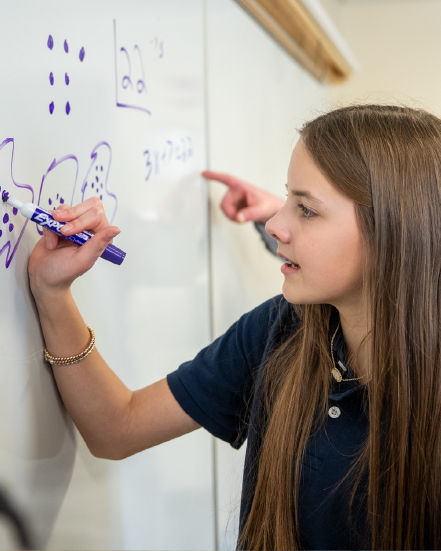
At Xavier Catholic schools, 98 percent of parents use ESAs worth $8,000 to pay tuition. The money made Xavier affordable for Stephanie King. She's not Catholic, but she moved her daughter from public school to avoid classroom distractions, such as fighting and yelling.
ESAs have allowed Iowa's private schools to raise tuition, researchers conclude. Parents can afford to pay more.
Xavier is charging more -- but still less than the full cost of educating students -- says Chris McCarville, president of the network. "Catholic families will pay between $9,000 and $10,000 a year," slightly more than the voucher, writes Turner. "Families who don’t attend local Catholic churches will pay a little more.”
While charters must take all students who apply, private schools do not, Turner notes. They "can turn away a child for poor grades, or a history of misbehavior," and are allowed to "reject a child with a disability by saying they don't have the resources it would require" to educate the student.
Clearly, choice is working for some families, he concludes. "The question . . . is whether a growing education marketplace can be made to work for everyone – even the most vulnerable children."
Iowa's choice-energized education marketplace should be compared to reality, writes Neal McCluskey in response. Are the public schools working for everyone?
The Cedar Rapids district can assign students to alternative schools based on behavior or disability, he writes. Students with “mild and moderate” disabilities are accepted at every school. Those with severe disabilities are placed in specialized private schools that have the resources to help them at district expense.
Most students with behavioral problems are in mainstream classrooms. That's one reason families are leaving district schools, writes McCluskey.
According to the district's FY25 budget, Cedar Rapids has per-pupil revenue of $18,418, more than twice the $8,000 ESA voucher and double the tuition at Catholic schools.
Cedar Rapids' public students are performing below state averages, according to the district’s 2023-24 profile, he writes. Only 37 percent were prepared for college or career training, more than 40 percent were not proficient in math, and nearly 37 percent were not proficient in English Language Arts.
District students may face more challenges, such as poverty, than other Iowa students, McCluskey writes. But "the evidence does not support the idea that public schooling is working for everyone." Competition might force the district to improve.



The neighborhood public school cannot compete with charters or private schools if for no other reason than the local public school has to accept all students (in the attendance area) whereas the private, charter, or other school district can always dump their problem students back to the must admit public schools.
In reality, school choice programs are really just a way to accept much higher student failure rates by hiding the failure rates in the friction of school choice.
US DOE NCES District Directory
Cedar Rapids Community School District
2024-2025 enrollment: 15,224
2022-2023 revenue per pupil: $19,014
Joanne: "Oscar and Adam Kaiz-Vera, who moved three of their children to Prep, told Turner they worried about disorder in district schools. Teachers were too busy managing 'distracting behavior from other students' to give their daughter the extra learning support she needs, they said."
This is also the reason most often given by teachers who leave government schools before retirement age. This is one reason that competitive markets in goods and services generally outperform State-monopoly providers of goods and services. Parents and schools in a minimally-regulated market in education services meet on mutually agreed-upon terms. In government schools with enrollment assembled a…