


Can we celebrate America?

On her "History Rocks!" tour, celebrating America's 250th anniversary, Education Secretary Linda McMahon recites the Pledge of Allegiance with students. In a Buckley Institute speech last week, she recalled a principal who told students, "You're not pledging allegiance to any particular flag, but just to a spirit. So you can pledge this allegiance to whatever flag you think is appropriate for you."
This is wrong, writes Catherine Salgado on PJ Media. The Pledge specifies allegiance "to the flag of the United States of America, and to the Republic for which it stands." Those who don't wish to say the words may remain silent.
"History Rocks!" is controversial, seen as conservative and political, reports Laura Meckler in the Washington Post. Some stops have been canceled. At others, there have been protests.
Typically, McMahon gives a short speech and a history quiz. “Let’s hear it for the greatest country on Earth, the United States of America!” she usually says. The 250th anniversary is “a reminder of the courage and vision that built this nation.” It's not partisan, unless you think celebrating America is partisan.
However, the America 250 Civics Education Coalition that sponsors the tour "is composed of conservative and religious groups such as Turning Point USA, Moms for Liberty and the Heritage Foundation," and led by the pro-Trump America First Policy Institute, Meckler writes. Liberal and nonpartisan civics groups such as Civx Now are not involved.
The America First Policy Institute released a video promoting the tour that "is a nostalgic cry for a lost past," she writes. Once education was built on “faith, heritage, patriotism,” says the voice over, with photos show students praying in class and reciting the Pledge of Allegiance. Then "the screen flashes images including anti-war protests, flag burning, removal of a Christopher Columbus statue, the 1619 Project, President Barack Obama and a drag queen reading a story." President Trump and Secretary McMahon will restore the "light . . . to guide our students and our nation into a brighter American future,” the video concludes.
History Rocks! calls for Americans to "focus on celebrating all that is good about their country — a contrast to critics who say the study of U.S. history should center discussion of atrocities such as the nearly 250 years of enslaving Black people, and brutality and violence against Native Americans, writes Meckler.
I started school in the McCarthy Era: To the extent we learned history at all, it was the rah-rah America version the video extols. We learned the pledge in first grade. I remember the teacher explaining "allegiance" and "indivisible" to us. We came down hard on "liberty and justice for all."
But the pendulum has swung toward America-the-horrible. Students who know very little history are eager to condemn their country. The less they know, the more confident their opinions.
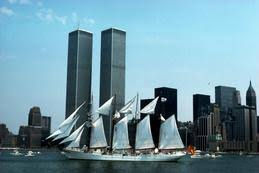
Fifty years ago, "the Bicentennial arrived in a country that could still celebrate itself," writes Robert Pondiscio in Commentary. As an eighth grader studying American history he was inspired by the Tall Ships.
These days, "we are more anxious and fragmented, less confident, and quite incapable of sharing a moment of uncomplicated civic pride," he writes. "Faith in those shared ideals feels rare, even endangered."
For two years before July 4, 1976, he recalls, CBS aired a nightly “Bicentennial Minute” — a brief history lesson on something that had happened exactly two centuries earlier: a battle or a speech in the Continental Congress. "Night after night" Americans were reminded that our "country had a collective past, a shared story we held in common."

Despite the challenges of the mid-1970's, including the Vietnam War and Watergate, Americans celebrated.
The Bicentennial was sentimental and sometimes kitschy, he writes. "It simplified history. It foregrounded heroes and ideals while soft-pedaling contradiction and failure." And yet, "it attached me to the country without asking or expecting me to judge it."
Like me -- I was writing for a community newspaper chain about fire hydrants painted in patriotic colors for the Bicentennial -- Pondiscio thinks children should learn to cherish America before they set out to change it.
"Indoctrination forecloses critique," he writes. "Informed patriotism makes examination and critique possible by giving young people a stake in the outcome. A citizen who feels no sense of belonging is not liberated, only detached — and detachment is a poor foundation for democratic self-government."


Excellent post.